Reading at Whitcliffe Mount
‘Reading should not be presented to children as a chore, or a duty. It should be offered as a gift.’ Kate Di Camillo
Reading is not just something some people do, or what happens in some lessons. Literacy and communication are essential skills for everybody in society. The ability to read fluently and articulate your ideas through speech and written forms, provide you with the voice to shape your future.
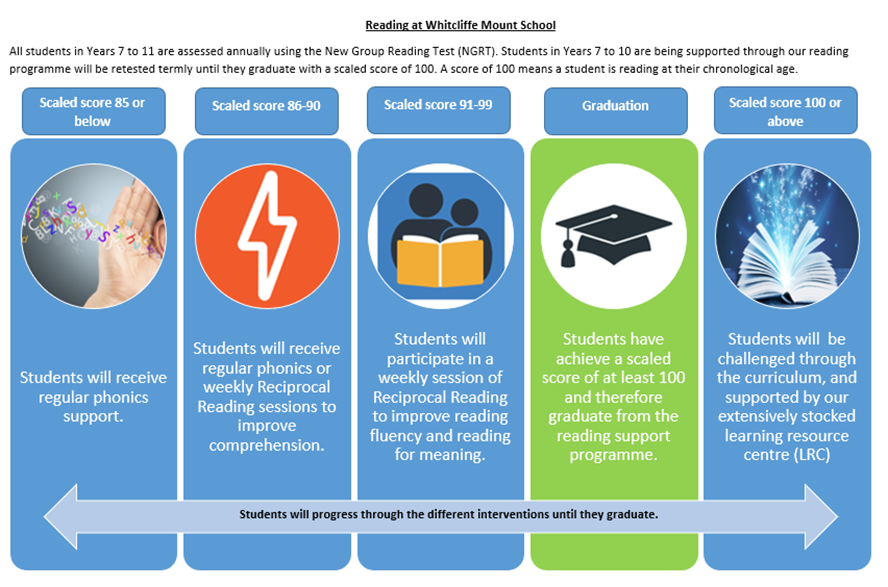
At Whitcliffe Mount, we aim to support the bespoke needs of our students and have the following strategies in place to help students develop confidence and fluency in reading in both Key Stage 3 and 4:
- Phonics to support students in the early phases of reading
- Bespoke literacy interventions for students who need to develop their comprehension and catch-up programmes.
- Reciprocal Reading, which is a structured approach to teaching strategies (questioning, clarifying, summarising and predicting) that is accessed by all students through our form time curriculum and in lessons.
Why is reading important?
We strongly believe that developing students' reading ability and love of reading is both an academic and moral issue:
'Young people who leave school without good literacy skills are held back at every stage of life. Their outcomes are poorer on almost every measure, from health and wellbeing, to employment and finance' (2020, Education Endowment Foundation).
We know that literacy and communication are essential life skills. To support this, we believe students should have the opportunities to be able to read fluently, speak confidently and write articulately.
How do we improve reading at Whitcliffe Mount?
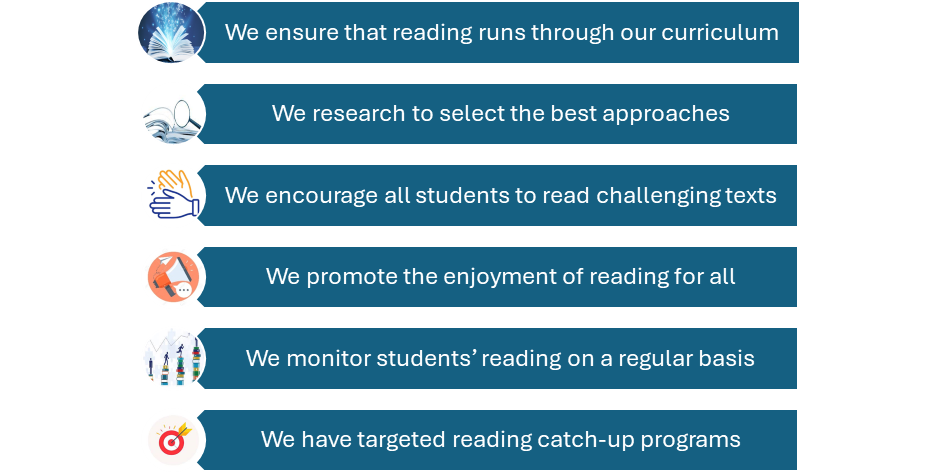
We have six key principles that underpin our approach to reading:
What research have we used?
- Geoff Barton, Don’t Call It Literacy,
- Education Endowment Foundation, Improving Literacy in Secondary Schools Guidance Report, 2019.
- Oxford School Improvement, Building an Outstanding Reading School, 2017.
Key Stage 3 – Supporting students and helping them to develop a love of reading.
In Key Stage 3, we aim to identify students’ reading ability and develop a love of reading. Our strategies include:
- Testing students on entry through the NGRT testing programme to evaluate reading abilities. Regular testing throughout KS3 ensures accurate monitoring of students’ reading ability.
- Introducing students to the school library and teaching them how to select appropriate books.
- Reciprocal Reading, which takes place in a structured weekly form time session and during subject lessons.
- KS3 Catch-up is used to close the gaps for students who require more intervention.
- Other bespoke interventions are used where required to support students, such as Phonics.
Key Stage 4 – Developing students into confident and independent readers.
In Key Stage 4, we aim to support students in reading confidently.
- NGRT tests are used in KS4 to ensure accurate monitoring of students’ reading ability.
- Developing reading fluency through the use of reciprocal reading in all lessons
- Encouraging students to read challenging and ambitious texts.
- Promoting wider reading through subject-selected texts.
- Promoting love of reading through a Young Adult section in the library which is available for KS4 only.
- Providing opportunities for paired reading between Key Stage 4 and Key Stage 3 students.
- Reciprocal Reading, which takes place in a structured weekly form time session and during subject lessons.